How agencies replace ebook lead magnets with personalized strategy
Let visitors generate their own 45-page strategy document. The agency receives prospects who’ve already read the pitch.
By Nico, Founder & Strategist, BrioPublished Updated
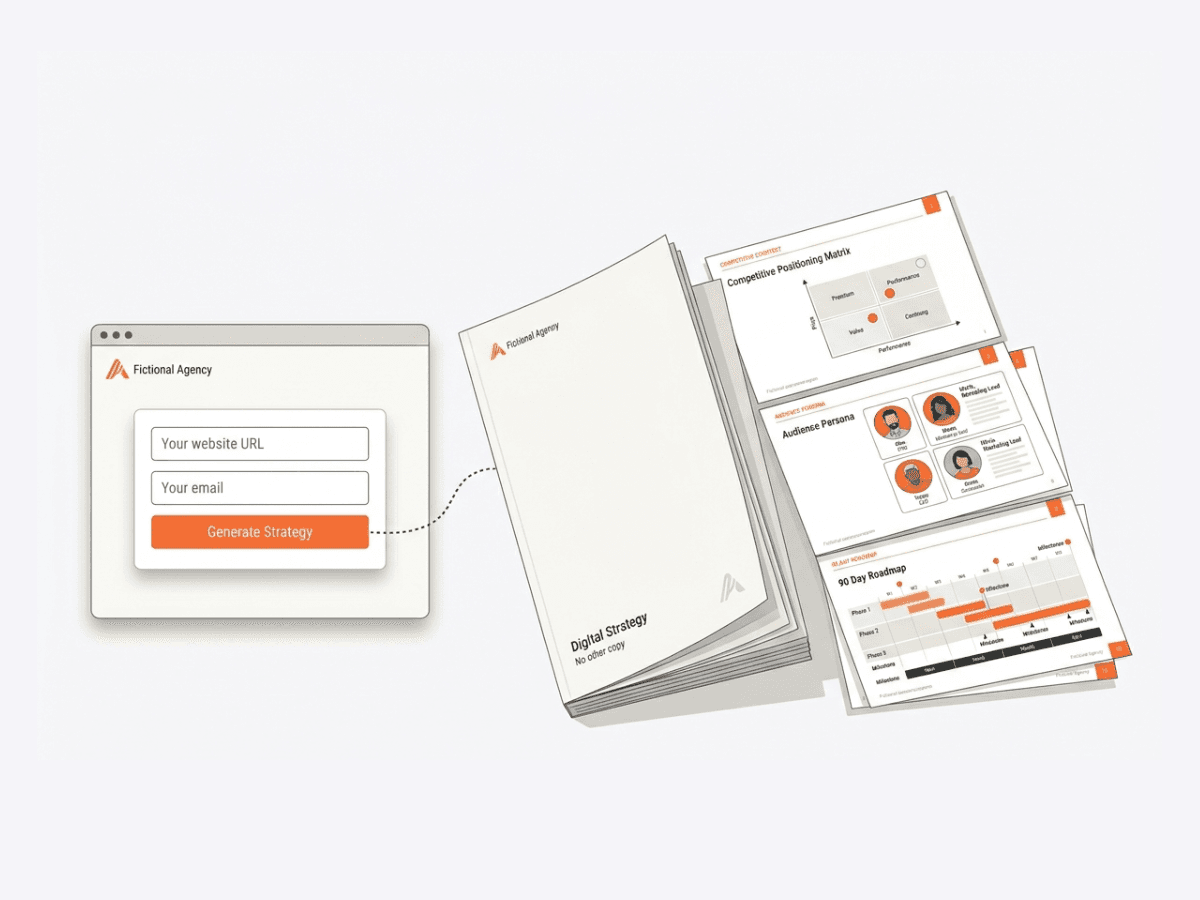
The agency that lets visitors generate their own strategy stops collecting leads and starts receiving conversations.
Of B2B buyers are less willing to share contact information in exchange for content than they were two years ago (Demand Gen Report, 2025)
Average conversion rate for B2B lead magnets in 2025. The ebook trade has collapsed (B2B Marketing Benchmark Report, 2025)
Of B2B buyers now prefer interactive content over static formats (Demand Gen Report B2B Content Preferences Survey, 2026)
Higher conversion rate on personalized content experiences compared to static content (Demand Gen Report, 2025)
Why are lead magnets failing?
Lead magnets are failing because buyers stopped trusting the trade. For a decade, the exchange was simple: give us your email, we’ll give you a PDF. That exchange is broken. According to Demand Gen Report, 80% of B2B buyers are now less willing to share contact information for gated content than they were two years ago. The average B2B lead magnet converts at just 4.7%, and most of that traffic is either unqualified or uninterested in a conversation.
The cause is not complicated. Buyers have been burned too many times by ebooks, whitepapers, and “ultimate guides” that delivered less than what was promised on the landing page. A generic PDF is no longer worth an email address, and buyers have adjusted their behavior accordingly. At the same time, Gartner research shows B2B buyers now spend only 17% of their customer journey in direct contact with vendors, with 60% or more of that journey happening in independent online research. The buyer wants strategic help. They just refuse to pay for it with a cold email.
The deeper problem is that agencies still need lead magnets. Inbound is not optional when 75% of B2B buyers prefer a rep-free experience and decision-makers are doing the majority of their research before they talk to anyone. The agency that can’t hand a visitor something valuable on first touch is the agency that never hears from them again.
91%
Prefer Interactive Content
Of B2B buyers now prefer interactive content over static formats.
Source: Demand Gen Report B2B Content Preferences Survey, 2026 →75%
Prefer a Rep-Free Experience
Of B2B buyers prefer a rep-free sales experience, doing most of their research before they ever speak to a salesperson.
Source: Gartner B2B Buying Survey, 2024 →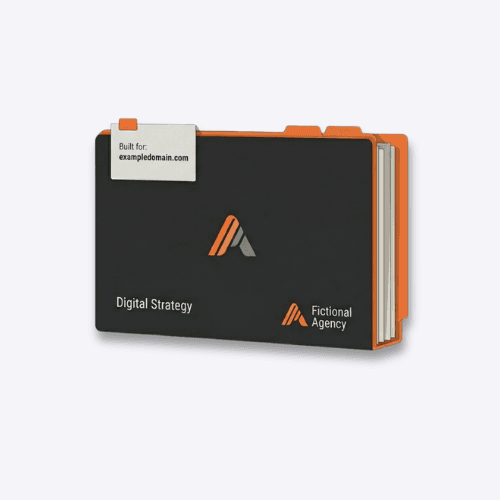
What is strategy-as-lead-magnet?
Strategy-as-lead-magnet is a lead generation shift where agencies replace their generic gated content with a personalized strategy document the visitor generates themselves. The visitor enters their URL and email on the agency’s website. Minutes later, they receive a 45-page strategy document built specifically for their business, white-labeled with the agency’s brand. The agency receives a prospect who has just read the agency’s strategic thinking about their own company, before any sales conversation has started.
The trade is fundamentally different from the ebook trade. A visitor giving up their email for a generic PDF is taking a gamble that the content will be useful. A visitor giving up their URL and email for a personalized strategy document knows exactly what they’re getting: their own business, analyzed, with competitors mapped and a 90-day plan attached. The value is specific, immediate, and visibly proportional to what the visitor gave up.
The same consultant-grade document works in three distinct positions across an agency’s pipeline: inbound on the site (the playbook described here), outbound as cold outreach to prospects (the strategy-as-outreach playbook), and sold as a fixed-price standalone offer (the productized strategy playbook). Most agencies start with one position and expand into the other two once the document earns its first few deals.
What does strategy-as-lead-magnet look like next to other lead magnets?
Strategy-as-lead-magnet sits at the top of a visible hierarchy of lead magnet formats, ranked by how much the buyer gets in return and how much the agency learns about the buyer in the process. The table below compares the three formats most agencies are using in 2026.
Sources: Demand Gen Report 2025; Demand Gen Report B2B Content Preferences Survey 2026; B2B Marketing Benchmark Report 2025.
Interactive tools are a real improvement over ebooks. Calculators, quizzes, and assessments deliver immediate, personalized value, and the conversion numbers reflect that. But they’re still shallow by design: they tell the visitor a number, not a strategy. The personalized strategy document is the evolution beyond interactive tools, because the depth of what the visitor receives is proportional to the depth of context they handed over. Giving up a URL is a much bigger trust signal than giving up a quiz answer, and what comes back has to earn that signal.
How does strategy-as-lead-magnet change the sales cycle?
Strategy-as-lead-magnet changes the sales cycle by collapsing discovery into the lead magnet itself. In the old model, an agency receives a lead from a gated ebook and then spends the first call asking questions: What’s your business? Who are your competitors? What have you tried? The conversation is a cold start, and the prospect has to do the emotional work of explaining their business to someone who doesn’t know it yet.
In the strategy-as-lead-magnet model, the first call is not a discovery call. It’s a review call. The prospect has already received a 45-page document that maps their competitive landscape, profiles their audience, and lays out a 90-day plan. They’ve read it, or at least skimmed it, before picking up the phone. The conversation starts from “here’s what I thought of the strategy” instead of “tell me about your business.” The agency is never in a cold first call again.
There’s a second, quieter shift. When the prospect opens the document and sees their own business reflected back, the buying frame changes. They are no longer evaluating whether to hire the agency. They are evaluating whether the strategy the agency already produced is the right strategy for them. That’s a much smaller question, and it’s the question that closes deals.
70%
Personalization Lift
Higher conversion rate on personalized content experiences compared to static content offerings.
Source: Demand Gen Report, 2025 →21×
Response Window Advantage
More likely a lead is to qualify when contacted within 5 minutes compared to after 30 minutes. Brio generates the strategy document in under 5 minutes, which is the response window.
Source: InsideSales research via Martal B2B Benchmarks, 2026 →How can agencies run strategy-as-lead-magnet with Brio?
Agencies run strategy-as-lead-magnet with Brio by wiring Brio’s API to a form on their website. The agency owns the form, the branding, and the visitor experience. Brio runs the analysis and delivers the document. The visitor never sees the platform underneath.
Add the form to your website
A simple form with two fields: the visitor’s website URL and their email. Your copy, your branding, your landing page. Position it anywhere on your site where an ebook or audit form currently sits.
Connect the form to Brio’s API
When a visitor submits, your form calls Brio’s API with the URL. Brio detects the business model, runs the full analysis, and generates a 45-page consultant-grade strategy document, white-labeled with your brand, in under 5 minutes.
Deliver the document, follow up on a warm relationship
The visitor receives the document in their inbox, signed by your strategist. Your CRM receives the lead with full business context attached. You follow up on a prospect who has already read your strategic thinking about their business, not a cold email address.
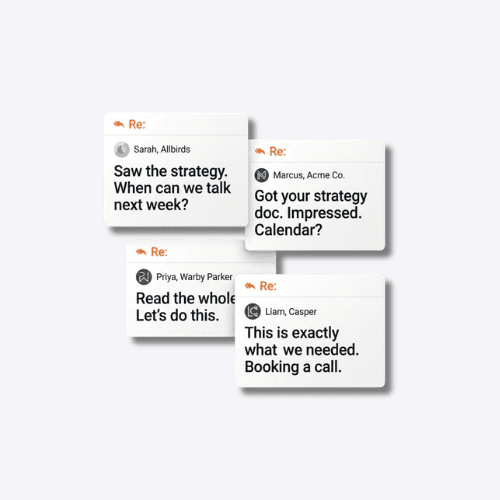
The lead magnet that doesn’t need a sales call.
A visitor lands on your site looking for an agency. They see a form: enter your URL, get a strategy document for your business. They’re skeptical, but the trade feels fair. They submit.
Five minutes later, a 45-page strategy document with your agency’s logo on the cover arrives in their inbox. They open it. They see their competitors mapped, their audience profiled, their next 90 days planned. It’s the first time an agency has shown them something real before asking for a meeting.
→ They reply to schedule a call. The discovery is already done.

Nico
Founder & Strategist, Brio
Founder & Strategist at Brio. 20 years building digital strategy across the US and Europe, including roles at Digital Silk and NASDAQ-listed companies (Scientific Games, The Stars Group). Built Brio to solve the problem he watched agencies struggle with for two decades: scaling personalized outreach without burning senior hours.
Frequently Asked Questions
How is this different from a free audit tool?
A free audit tool runs a generic checklist on the visitor’s website and returns a score or a list of issues. A strategy-as-lead-magnet generates a 45-page consultant-grade document covering competitive intelligence, audience profiles, positioning, and a 90-day roadmap. The difference is depth: an audit tells the visitor what’s broken, a strategy document tells them what to do.
Won’t visitors feel tricked when they realize a tool generated the document?
The visitor doesn’t see a tool. They see a strategy document with your agency’s brand on every page, generated specifically for their business. The document is white-labeled end to end. What the visitor experiences is your agency doing the work, fast, which is exactly what they wanted when they filled out the form.
Does the lead magnet replace my existing content marketing?
It replaces the ebook trade. Your blog, your thought leadership, and your long-form content still belong on the site as ungated value. What the strategy-as-lead-magnet replaces is the gated PDF most visitors no longer consider a fair exchange for their email.
What happens when the visitor’s email isn’t a real decision-maker?
The form captures the visitor’s URL along with their email, which means you have the full context of their business regardless of who filled out the form. If the person who submitted is a marketing coordinator rather than a founder, you still have the strategic document to share with whoever on their team actually makes the call.
Does this work for agencies with low site traffic?
Yes. Strategy-as-lead-magnet is not a volume play. A site that generates 50 visitors per month and converts 5 of them into deeply qualified strategy conversations is doing more real sales work than a site that generates 500 visitors per month into a generic ebook funnel. The point is the quality of the conversation, not the number of emails collected.
Can I use this alongside paid traffic?
Yes, and agencies running paid traffic typically see the strongest results from strategy-as-lead-magnet because the offer is specific enough to justify the ad spend. Generic ebook offers struggle on paid because the value is abstract. “Get a free strategy document for your business” is a conversion surface paid traffic actually engages with.