How agencies sell strategy as a product
Stop giving strategy away in unpaid pitch decks. Sell it as a fixed-price offer clients buy on its own.
By Nico, Founder & Strategist, BrioPublished Updated
The agency that sells strategy as a product, not a favor, opens doors retainers never will.
Average staff time an agency spends on a single unpaid pitch, equivalent to 22.2 staff days (TrinityP3 OUCH! Factor Report, 2021)
Average cost in non-billed agency hours per pitch, absorbed by staff on unpaid overtime (TrinityP3 OUCH! Factor Report, 2021)
Unbilled hours the average agency spends pitching each year. $475,000 of agency time that never sees an invoice (TrinityP3 OUCH! Factor Report, 2021)
Average rate a digital marketing consultant charges clients. The same strategy work, priced when it’s billable (Credo Digital Marketing Industry Pricing Survey, 2022)
Why is agency strategy work so unprofitable?
Agency strategy work is unprofitable because most of it is given away for free. Senior strategists spend weeks producing pitch decks, audits, and “strategic perspectives” to win accounts the agency may never land, and the hours never become an invoice. According to the TrinityP3 OUCH! Factor Report, the average agency spends 175 hours on a single unpaid pitch, equivalent to 22.2 staff days, at a cost of $44,000 in non-billed time. The same report found that the average agency spends 1,913 hours per year on pitching overall, which translates to $475,000 of unbilled agency time burned chasing accounts.
The win rate makes the math worse. Agencies win less than half the pitches they enter, which means more than half of those 175-hour investments are written off entirely. Even on the wins, the time-to-profit is brutal: the OUCH! Factor Report found that the average won pitch takes 14 months to become profitable, based on 15% EBITDA. Strategy, in this model, is a high-cost customer acquisition expense dressed up as a service line.
The deeper problem is cultural. Agencies have trained clients to expect strategy for free, on the assumption that strategy is the cost of winning implementation work. That assumption made sense when implementation margins were fat. They aren’t anymore.
175
Hours Per Pitch
Average staff time an agency spends on a single unpaid pitch, equivalent to 22.2 staff days.
Source: TrinityP3 OUCH! Factor Report, 2021 →$141.67/hr
Billable Consultant Rate
Average rate a digital marketing consultant charges clients. The same strategy work, priced when it’s billable.
Source: Credo Digital Marketing Industry Pricing Survey, 2022 →
51%
Market Volatility
Of digital agencies cite market volatility as their number one obstacle, driving a shift toward productized services as a solution.
Source: SoDA + Forrester, 2023 →What is productized strategy?
Productized strategy is a positioning shift where agencies stop offering strategy as free pre-sale work or custom billable-hour engagements, and start selling it as a standalone, fixed-price, fixed-turnaround product. The client pays for strategy on its own, before any retainer conversation happens. The agency stops absorbing senior hours on prospects who may never sign.
The shift is not new in spirit. Productized services have been gaining ground across agencies for years as a response to the volatility of project work. According to research from SoDA and Forrester, 51% of digital agencies now cite market volatility as their number one obstacle, and productized services are the most common strategic response. What’s new is that strategy specifically, long considered the least productizable service an agency offers, can now be delivered at the same quality bar as a custom engagement in a fraction of the time. The bottleneck that kept strategy custom has finally loosened. Agencies already using our strategy-as-outreach playbook layer productized strategy on top of their cold outreach pipeline, and agencies running a website-first offer pair it with the strategy-as-lead-magnet playbook so visitors can generate the same document on their own.
How do you run a productized strategy offer?
Running a productized strategy offer at an agency comes down to four operating decisions: how you list it, how you price it, how you deliver it, and how you use it to open retainer conversations. Each of the four is a distinct decision, and any one of them done wrong collapses the offer back into hourly work.
Listing
A productized offer lives on your website as a real line item with a real price.
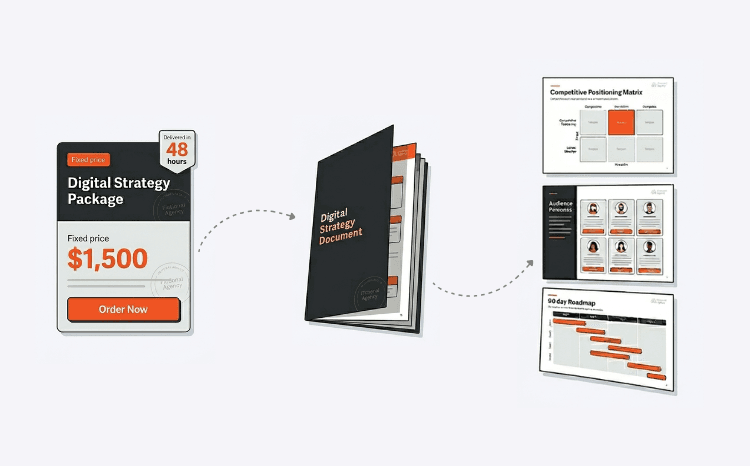
“Digital Strategy Package. $1,500. Delivered in 48 hours. White-labeled with your brand.” Not hidden behind a contact form. Not “starting at.” The price is public, the turnaround is public, and the buy button is one click. If the offer requires a proposal, it isn’t productized.
Pricing
Most agencies price productized strategy offers between $1,000 and $3,000.
The sweet spot sits around $1,500. High enough to filter tire-kickers and signal real value, low enough to clear without procurement friction. The goal is not maximum margin per sale. It is opening relationships that lead to retainers, with the offer itself carrying its weight.
Delivery
A consultant-grade strategy document, 40 to 50 pages, fully white-labeled.
Covering competitive intelligence, audience profiles, positioning, a content roadmap, and a 90-day action plan. White-labeled end to end: your logo, your brand colors, your strategist’s name on every page. The client experiences your agency’s work, not a platform. Turnaround is 48 hours, the sales hook.
Upselling
The last section of the document surfaces the work that comes next.
Implementation, content production, paid media, ongoing optimization. The retainer conversation is no longer something you pitch. It’s something the document invites. Clients who bought the strategy offer are pre-qualified for the retainer in a way cold prospects never are, because they already know the thinking.
What are the unit economics of productized strategy compared to unpaid pitching?
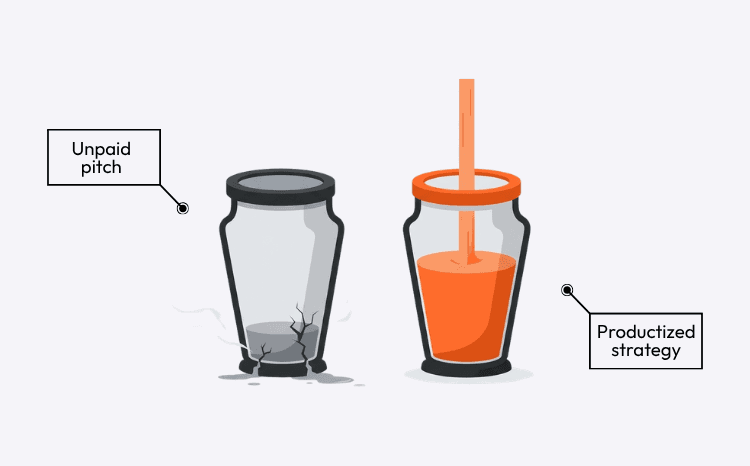
The unit economics of productized strategy are the reverse of the unpaid pitch model — the industry norm where agencies produce weeks of unbilled strategy work to compete for new business. In the pitch model, the agency invests senior hours up front hoping to be paid later. In the productized strategy model — strategy sold as a fixed-price, fixed-scope offer clients buy before any hours are spent — the agency collects payment before the work begins. The table below compares the two head-to-head using industry benchmarks.
The transformation is stark when you stack the two columns. An agency running the unpaid pitch model commits 1,913 hours per year to winning accounts that may never land, and waits 14 months after the win to see profit. An agency running the productized strategy model collects revenue on every single delivery, before a single hour is spent on the work, and has no sunk cost on prospects who don’t buy.
Sources: TrinityP3 OUCH! Factor Report, 2021; Credo Digital Marketing Industry Pricing Survey, 2022; Brio product claims for production time.
How can agencies productize strategy with Brio?
Agencies productize strategy with Brio by using it as the delivery engine behind a fixed-price, fixed-turnaround offer. The agency sells the offer. Brio produces the 45-page white-labeled document in under 5 minutes. The client pays for the strategy, not the platform underneath it.
List the offer on your site
A clear SKU with a fixed price and a fixed turnaround. “Digital Strategy Package. $1,500. Delivered in 48 hours.” No proposal required, no scope conversation, no discovery call before purchase.
Run the client’s URL through Brio
Enter the client’s domain. Brio detects the business model, runs the analysis, and delivers a 45-page consultant-grade strategy document, white-labeled with your brand, in under 5 minutes. No intake forms. No senior hours spent on production.
Deliver, then walk them into the retainer
Send the document. Book a review call. The next step, implementation, retainer, ongoing optimization, is already surfaced on the last page of the document. You’re having the expansion conversation, not the pitch.
1,913 hrs
Annual Unbilled Hours
Unbilled hours the average agency spends pitching each year. $475,000 of agency time that never sees an invoice.
Source: TrinityP3 OUCH! Factor Report, 2021 →14 months
Time to Profitability
Time required before a won pitch becomes profitable for the average agency, based on 15% EBITDA.
Source: TrinityP3 OUCH! Factor Report, 2021 →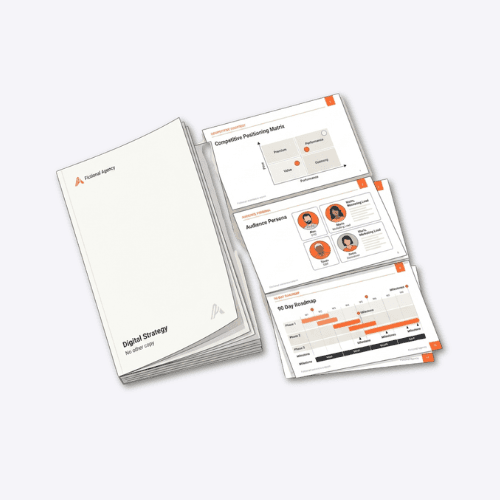
The offer that opens doors retainers can’t.
A prospect you’d never have pitched a retainer to lands on your site. They see a strategy package with a price and a 48-hour turnaround. They pay $1,500 without a proposal call.
Two days later, a 45-page strategy document with your logo on the cover lands in their inbox. Three weeks later, they’re asking about implementation.
→ The strategy offer paid for itself. The retainer it opened is the real win.

Nico
Founder & Strategist, Brio
Founder & Strategist at Brio. 20 years building digital strategy across the US and Europe, including roles at Digital Silk and NASDAQ-listed companies (Scientific Games, The Stars Group). Built Brio to solve the problem he watched agencies struggle with for two decades: scaling personalized outreach without burning senior hours.
Frequently Asked Questions
How is productized strategy different from a billable strategy engagement?
A billable engagement is priced by the hour, scoped in a proposal, and delivered over weeks. A productized strategy offer has a fixed price, a fixed scope, and a fixed turnaround. The client buys it like they’d buy software, not like they’d hire a consultancy. The difference is what makes it sellable to clients who would never commit to a six-week engagement.
Won’t clients expect more than a document for $1,500?
A 45-page strategy document with competitive intelligence, audience profiles, a positioning framework, and a 90-day roadmap is not a light deliverable. Clients who buy strategy offers are buying clarity and direction, not volume. What they want is something they can act on, and that’s exactly what the document provides.
What should I charge for a productized strategy offer?
Most agencies price productized strategy offers between $1,000 and $3,000, with the sweet spot around $1,500 for agencies without an established premium brand. The price needs to be high enough to signal real value and filter out tire-kickers, low enough to clear without procurement friction. The goal is not maximum margin per sale. The goal is opening relationships that lead to retainers.
How fast do agencies realistically deliver a productized strategy offer?
With Brio, the document is ready in under 5 minutes. Most agencies promise 48 hours to leave room for internal review, a quick brand pass, and a personal note from the strategist. The 48-hour promise is the sales hook. The 5-minute generation is the margin.
Does productized strategy cannibalize retainer sales?
The opposite. Productized strategy offers open conversations with clients who would never have booked a retainer cold. The document surfaces the implementation work that comes next, and the retainer becomes the natural second step. The offer is a first-touch product, not a replacement for the retainer.
Can I sell productized strategy to clients who aren’t ready for a retainer?
That’s the core use case. Productized strategy is a first-touch product. It lets you say “yes” to clients who want help but aren’t ready to commit to a retainer, and gives you a real revenue line from relationships that used to go nowhere.