How agencies craft an RFP response that beats bigger competitors
Every RFP response in the stack looks the same. An embedded strategy document is what lifts yours off the pile.
By Nico, Founder & Strategist, BrioPublished Updated
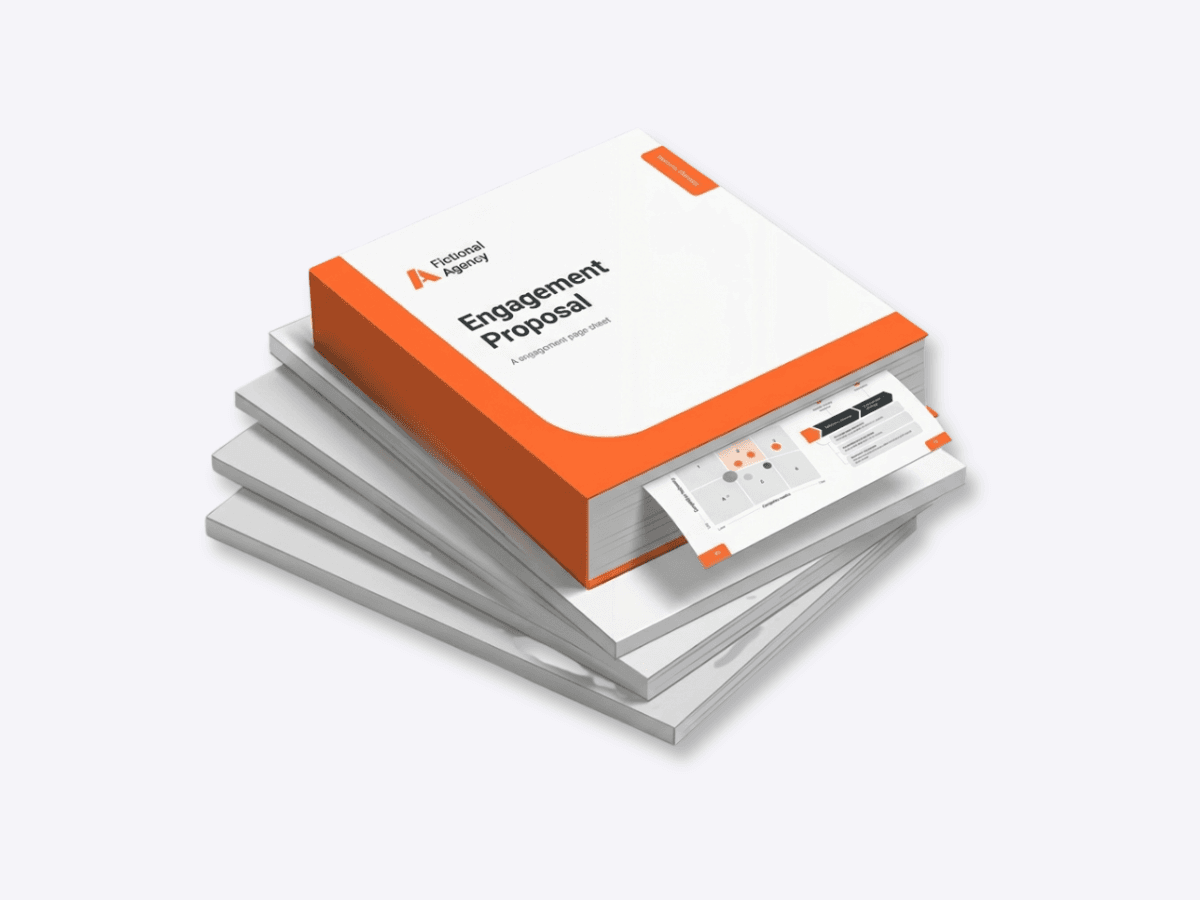
The agency that arrives with the work already started is the only one in the stack that isn’t a proposal.
Average RFP win rate across 1,500+ teams worldwide. More than half of every agency’s RFP effort doesn’t convert (Loopio RFP Response Trends and Benchmarks Report, 2026)
Of bid losses are attributed to competition, agencies losing not on price but on indistinguishability from other agencies in the stack (Loopio, 2026)
Average shortlist advancement rate, down from 54% the prior year. The gate to the finalist round is getting harder (Loopio, 2026)
Average staff time an agency spends on a single unpaid pitch. Multiplied across every RFP that doesn’t convert (TrinityP3 OUCH! Factor Report, 2021)
Why are most RFPs lost?
Most RFPs aren’t lost on price. They’re lost on indistinguishability. According to Loopio’s 2026 RFP Response Trends and Benchmarks Report, based on data from more than 1,500 teams worldwide, the top reason agencies lose bids is competition, at 55%, statistically tied with price. More than half of every loss happens not because the agency was too expensive, but because the procurement team couldn’t tell the agency apart from the other four or five responses sitting next to it in the stack.
The diagnosis has been named in the sales literature for years. The RAIN Group framework — a B2B sales research program’s model of how winners and losers split in competitive deals — puts it directly: sellers don’t have a pricing problem, they have a differentiation problem. Most agency responses sound identical to procurement teams. Same capability claims. Same case study formats. Same “Our Approach” section with three or four bullets describing discovery, strategy, and execution. When evaluators can’t distinguish between options, they default to price, not because price is the issue, but because the agency failed to give them anything else to score on.
46%
Average shortlist advancement rate, down from 54% the prior year. The first cut is getting harder.
Source: Loopio RFP Response Trends and Benchmarks Report, 2026 →25 hrs
Average time an agency spends responding to a single RFP. Multiply that by every RFP that doesn’t convert.
Source: Bidara RFP Statistics, 2026 →

What does the RFP stack actually look like at the procurement desk?
The procurement team or evaluation committee receives five, eight, sometimes ten responses for the same opportunity. They have a finite amount of attention and a scoring rubric to fill out. They open the responses one by one. The first three or four start to blur together. Capability slides about “data-driven approaches” and “client-centric methodology.” Case study spreads with similar layouts and similar metrics. “Our Approach” sections with three or four bullets that all sound competent and all sound the same.
By the time the evaluator reaches the sixth response, they’re scanning. By the eighth, they’re looking for reasons to eliminate. The responses that get pulled out of the stack and remembered are the ones that contain something specific, something the evaluator hadn’t seen yet, something that proves the agency understood the prospect’s actual business rather than just submitting a polished version of their standard pitch.
A 45-page strategic analysis of the prospect’s business, their competitors mapped, their audience profiled, a 90-day roadmap drafted, is the most specific thing an agency can put inside an RFP response. It’s the only element in the response that cannot be reused from a previous bid, and it’s the only element that visibly required real work. The procurement team doesn’t have to be told the response is different. They see it.
How does an embedded strategy document change the scoring?
The scoring math is structural. According to World Bank procurement guidance via Arphie’s analysis, technical approach typically receives 40 to 60 percent of total scoring weight in most RFP rubrics. That’s the largest weighted category in the entire evaluation. A generic capabilities deck competes for partial credit on that 40 to 60 percent because evaluators can only score what’s actually in the response, and “we’ll do discovery, then strategy, then execution” is not scorable as deep technical understanding.
A 45-page strategy document changes what’s available to score. The evaluator now has concrete artifacts to evaluate: the agency’s actual analysis of the prospect’s competitive position, their actual audience segmentation, their actual content roadmap. The technical approach section stops being a promise and becomes a deliverable. The agency that submitted the strategy document doesn’t compete for partial credit. They compete for full credit on the largest weighted category in the rubric.
Technical approach is where responses are distinguished.
Source: World Bank procurement guidance via Arphie →175 hrs
Average staff time an agency spends on a single unpaid pitch. The cost of every RFP that doesn’t convert.
Source: TrinityP3 OUCH! Factor Report, 2021 →2×
Higher profit margin agencies achieve through real differentiation, according to APMP research. Generic responses compete on price. Differentiated responses command premium.
Source: APMP via Responsive RFP Differentiator Benefits, 2025 →How can agencies upgrade RFP responses with Brio?
Agencies upgrade their RFP responses with Brio by generating a 45-page strategy document for the prospect’s business and embedding it directly into the RFP response template. The agency’s standard response structure stays the same. The “Our Approach” or technical methodology section gets replaced with proof of work the other responses in the stack don’t contain.
Generate the prospect’s strategy brief from their URL
Brio takes the prospect’s domain, detects the business model, runs the analysis, and returns a 45-page consultant-grade strategy brief — white-labeled with your brand — in under 5 minutes.
Embed the strategy document into your RFP response
Drop the document into your existing RFP template as the technical approach section, as a strategic appendix, or as a standalone deliverable referenced in the executive summary. Your response’s compliance, capabilities, and pricing sections stay where they are.
Submit the response that doesn’t look like the others
Your response arrives in a stack of capability decks. The procurement team opens it. The strategic analysis pulls them in. The other responses get scored against this one, not the other way around.

The response that doesn’t read like a response.
Your agency has been invited to an RFP alongside four bigger competitors. Two of them have offices on three continents. One of them won “Agency of the Year” last quarter. You’ve been here before. You know how it ends.
This time, you submit a different response. Same capabilities slides, same case studies, same pricing. But where the “Our Approach” section used to be, there’s now a 45-page strategy document mapping the prospect’s competitors, profiling their audience, and laying out a 90-day plan. The procurement team opens five responses. They remember one.
→ They remember yours.

Nico
Founder & Strategist, Brio
Founder & Strategist at Brio. 20 years building digital strategy across the US and Europe, including roles at Digital Silk and NASDAQ-listed companies (Scientific Games, The Stars Group). Built Brio to solve the problem he watched agencies struggle with for two decades: scaling personalized outreach without burning senior hours.
Frequently Asked Questions
How is this different from upgrading a regular proposal?
A regular proposal is a one-on-one conversation with a single prospect. An RFP is a competitive shootout where your response sits in a stack alongside other agencies’ responses, all reviewed against the same scoring rubric. The dynamic is different: you’re not just trying to convince one prospect, you’re trying to be the most distinguishable response in a comparative review. A strategy document does both jobs, but in an RFP context it specifically wins on the differentiation axis that procurement teams use to make their first cut.
How do I integrate the strategy doc into our existing RFP response template?
The strategy document is delivered as a white-labeled PDF, which you can embed wherever your RFP template puts your technical approach or methodology section. Most agencies place it in the section the RFP scoring rubric explicitly weights, typically labeled “Technical Approach,” “Methodology,” or “Strategic Recommendation.” Your compliance sections, capability slides, references, and pricing stay exactly as they are.
What if we still lose to bigger agencies despite this?
Some RFPs are wired for incumbents or for an agency the prospect has already informally selected. No proposal innovation will win those. What changes with this approach is your win rate on the RFPs that are genuinely open. The Loopio data shows competition is the top reason for losses at 55%. A strategy document moves you out of the indistinguishable middle of the stack, which is where the genuinely-open RFPs are won.
Won’t the prospect just take our strategy and use it without picking us?
The 45-page strategy document is too substantial for a prospect to execute on their own. Mapping competitors is one thing; running a 90-day implementation across content, channels, and conversion optimization requires the agency. The strategy document is the proof of thinking. The retainer or project work is what executes against it. Prospects who receive substantive strategy don’t take it and run, they hire the agency that produced it because they want the same depth applied to the implementation.
What about the finalist presentation stage?
Most RFPs that get to a finalist presentation include a 30-60 minute pitch from each shortlisted agency. The strategy document gives you a different presentation entirely. Other finalists walk through capability slides and team bios. You walk through the strategic analysis they’ve already read, going deeper on the competitive insights and surfacing implications they hadn’t considered. The presentation becomes a working session, not a pitch.
How does this work for very large enterprise RFPs with rigid format requirements?
Most enterprise RFPs require specific sections in specific formats, and most also include a section for technical approach, strategic recommendation, or proposed methodology. The strategy document fits inside that section as the agency’s response to the technical approach question. If the RFP forbids attachments, the strategy document can be summarized as the body of that section with a reference to the full document available on request. The format flexes; the substance is what wins.