How agencies turn stalled proposals into signed deals
Stop sending proposals that ask the prospect to take a leap of faith. Embed the strategy document and the leap is already done.
By Nico, Founder & Strategist, BrioPublished Updated
The agency that sends proof of the work alongside the proposal closes the deals that everyone else loses to “let me think about it.”
Of B2B deals are lost to “no decision,” not to competitors or pricing. The proposal stalls, the prospect goes silent, the deal dies (Dixon & McKenna, The JOLT Effect, HBR 2022)
Of complex B2B deals show medium-to-high levels of customer indecision. Indecision is the rule, not the exception (Challenger Inc analysis of The JOLT Effect research, 2024)
Longer than 2021. The time it takes to close a B2B deal today. Proposals sit longer. Prospects stall longer. Champions go cold (Ebsta x Pavilion B2B Sales Benchmarks, 2024)
Post-proposal win rate at half of B2B companies. Even at the proposal stage, more than half of qualified deals don’t close (Norwest Sales & Marketing Benchmark Report, 2024)
Why do proposals stall?
Proposals stall because prospects are paralyzed, not skeptical. The conventional wisdom says agencies lose late-stage deals to competitors or to pricing objections. The data says otherwise. Research from Dixon and McKenna’s The JOLT Effect — the B2B sales framework that diagnosed why deals die from buyer indecision rather than competition — found, from analysis of more than 2.5 million recorded sales conversations, that 40 to 60 percent of B2B deals are lost not to competitors and not to “no,” but to no decision at all. The prospect agrees the agency could deliver. They agree the price is reasonable. They agree the timing makes sense. And then they say “let me think about it,” and the deal dies.
The cause has a name. Dixon and McKenna call it Fear of Messing Up (FOMU). When a prospect is at the proposal stage, the rational evaluation is over. The emotional one has just begun. The prospect is no longer asking “is this the right agency?” They are asking “what happens if I’m wrong?” Their fear isn’t of the agency failing. It’s of being personally responsible for hiring an agency that fails. And when that fear sits unresolved, the prospect’s safest move is no move at all.
The data on indecision is staggering. Challenger’s analysis of the JOLT Effect research found that 87% of complex B2B deals show medium-to-high levels of customer indecision. It’s not an edge case. It’s the default state of every prospect at the proposal stage. And it’s getting worse: Ebsta and Pavilion’s 2024 benchmark found that B2B sales cycles are now 38% longer than they were in 2021. Proposals sit longer. Champions cool down. Buying committees grow. The window between “send proposal” and “close deal” has become the most dangerous stretch of the entire sales cycle.
87%
Indecision Is The Default
Of complex B2B deals show medium-to-high levels of customer indecision. Indecision is the default state, not the exception.
Source: Challenger Inc analysis of The JOLT Effect, 2024 →38%
Longer Sales Cycle
Longer than 2021. The average B2B sales cycle today. The proposal stage has become the most dangerous stretch.
Source: Ebsta x Pavilion B2B Sales Benchmarks, 2024 →

What’s wrong with a generic strategy section?
A generic strategy section in a proposal is the part that triggers FOMU instead of resolving it. Every agency proposal includes some version of an “Approach” or “Methodology” section: three or four bullets describing how the agency will engage with the project. We’ll start with discovery. We’ll build a roadmap. We’ll execute against KPIs. The bullets are accurate. They’re reasonable. They’re also indistinguishable from what every other agency in the running has written, and they require the prospect to take everything on faith.
That faith is the problem. According to Mercer Island Group’s analysis of thousands of agency proposals, the questions clients actually use to evaluate proposals are these: Did the agency understand the core business issue? Did they understand the context and implications? Was the strategic analysis thorough and actionable? A generic strategy section answers none of these. It promises that analysis will happen. It doesn’t deliver any. The prospect has to imagine what the agency would actually produce, and imagining is exactly the cognitive activity FOMU thrives in.
The prospect’s silent question becomes: “Will this agency actually deliver what they’re promising?” That question has no good answer in a generic proposal because the only evidence the prospect has is more promises. The deal doesn’t stall because the prospect doesn’t trust the agency. It stalls because the prospect can’t reduce the unknown enough to feel safe signing.
What changes when the strategy is already in the proposal?
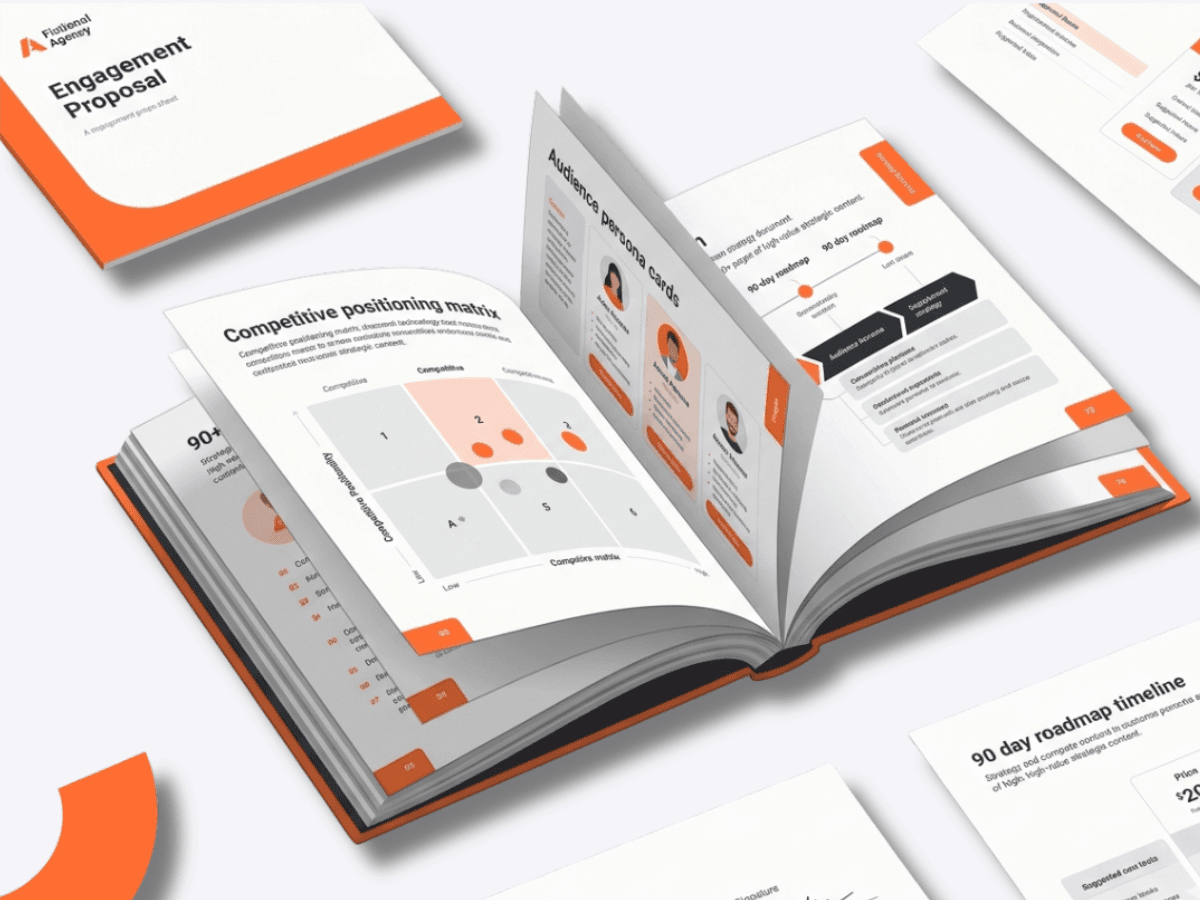
The proposal stops asking the prospect to take a leap of faith because the leap has already been taken. Embedded inside the proposal is a 45-page strategy document built specifically for the prospect’s business: their competitors mapped, their audience profiled, a content roadmap drafted, a 90-day action plan sequenced. The prospect doesn’t have to imagine what the agency would produce. They are holding it.
Three things change at the prospect’s desk.
The evaluation question changes.
The prospect stops asking “will this agency actually deliver?” and starts asking “is the strategy they’ve already produced the strategy I want implemented?” That second question is smaller, more concrete, and far less loaded with FOMU. The prospect is no longer evaluating a promise. They are evaluating a deliverable.
The discount conversation changes.
With only an approach summary, the prospect thinks “I’m paying for work that hasn’t started yet.” Discount pressure is high because the perceived value is abstract. With a 45-page strategy document, the work has visibly started. The agency has produced something substantial. Pressure drops because the prospect sees what they’re getting.
The close rate changes.
Agencies running this approach see proposals close that previously would have stalled in “let me think about it” limbo. The 31 to 50 percent post-proposal win rate that’s typical across B2B becomes the floor, not the ceiling. The deals that used to die in indecision close because indecision no longer has anywhere to live.
44% / 56%
Of no-decision losses are status quo holdouts. The remaining 56% are prospects who want to buy but can’t overcome their own fear of messing up.
Source: Dixon & McKenna, The JOLT Effect, HBR 2022 →31-50%
Post-proposal win rate at half of B2B companies. Even at the proposal stage, more than half of qualified deals never close.
Source: Norwest Sales & Marketing Benchmark Report, 2024 →How can agencies upgrade their proposals with Brio?
Agencies upgrade their proposals with Brio by generating a 45-page strategy document for the prospect’s business and embedding it directly into the existing proposal template. The agency’s proposal structure stays the same. The “Approach” section gets replaced with proof.
Run the prospect’s URL through Brio
Enter the prospect’s domain. Brio detects the business model, runs the analysis, and delivers a 45-page consultant-grade strategy document, white-labeled with your brand, in under 5 minutes.
Embed the strategy document into your proposal
Drop the document into your existing proposal as an appendix, a middle section, or a standalone deliverable referenced in the cover letter. Your proposal’s pricing, terms, and timeline stay where they are. The strategy section becomes the centerpiece.
Send the proposal that closes itself
The prospect opens the proposal expecting a generic approach summary. They find a strategic analysis of their business instead. The conversation that follows isn’t about whether to hire the agency. It’s about when to start.
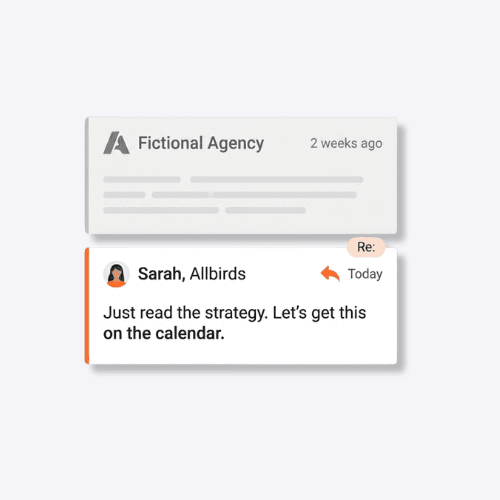
The proposal that doesn’t ask for faith.
A prospect has been sitting on your proposal for two weeks. They’ve been polite, but the energy has cooled. The follow-up emails get shorter. You’ve started to write the deal off.
This time, you send a different proposal. Same pricing, same terms, same timeline. But the “Our Approach” section is now a 45-page strategy document with their competitors mapped, their audience profiled, and their first 90 days planned. They open it within an hour.
→ They reply by end of day. The deal that was stalling closes the next week.

Nico
Founder & Strategist, Brio
Founder & Strategist at Brio. 20 years building digital strategy across the US and Europe, including roles at Digital Silk and NASDAQ-listed companies (Scientific Games, The Stars Group). Built Brio to solve the problem he watched agencies struggle with for two decades: scaling personalized outreach without burning senior hours.
Frequently Asked Questions
Doesn’t embedding a strategy document delay the proposal?
The strategy document is generated in under 5 minutes and embedded into your existing proposal template. There’s no delay to your proposal turnaround. If anything, it shortens the cycle: prospects who would have asked for “more details on your approach” before signing now have those details up front, which removes a back-and-forth round. If you’re earlier in the funnel and haven’t reached the proposal stage yet, see the strategy-as-outreach playbook for the same idea applied at first contact.
What if the prospect already has competing proposals from other agencies?
That’s exactly the scenario where this approach has the biggest impact. When the prospect is comparing three or four proposals side by side, every agency’s “Our Approach” section reads the same. The agency that includes a 45-page strategy document built for the prospect’s business is the only one that’s done real work. The comparison stops being agency-vs-agency and starts being “the agency that already started” vs. “the agencies that are still pitching.”
Does this work for retainer proposals as well as project proposals?
Yes, and arguably better. Retainer proposals carry the highest indecision risk because the commitment is open-ended. A 45-page strategy document at the front of a retainer proposal answers the prospect’s silent question (“what will this agency actually do for me month after month?”) with concrete strategic substance instead of capability bullets.
How do I integrate the strategy doc into our existing proposal template?
The strategy document is delivered as a white-labeled PDF, which you can embed as an appendix, insert as a middle section, or attach as a standalone deliverable referenced in the proposal cover. Your existing proposal template stays as it is. The strategy document plugs in wherever your “Approach” or “Methodology” section currently sits.
What if the prospect is too small to need a strategy doc?
Smaller prospects are more susceptible to FOMU, not less. A solo founder or a lean marketing team is often more afraid of hiring the wrong agency than an enterprise buyer is, because the cost of a wrong choice falls more directly on them. A strategic document built for their business reduces their fear in exactly the way the JOLT Effect research describes.
Will the strategy document leak our pricing or scope?
The strategy document covers competitive intelligence, audience profiles, positioning, content roadmap, and a 90-day action plan. It does not include your pricing, your scope, or your engagement terms. Those stay where they are in your proposal. The strategy document is the what. Your proposal is still the how much and the how it works.